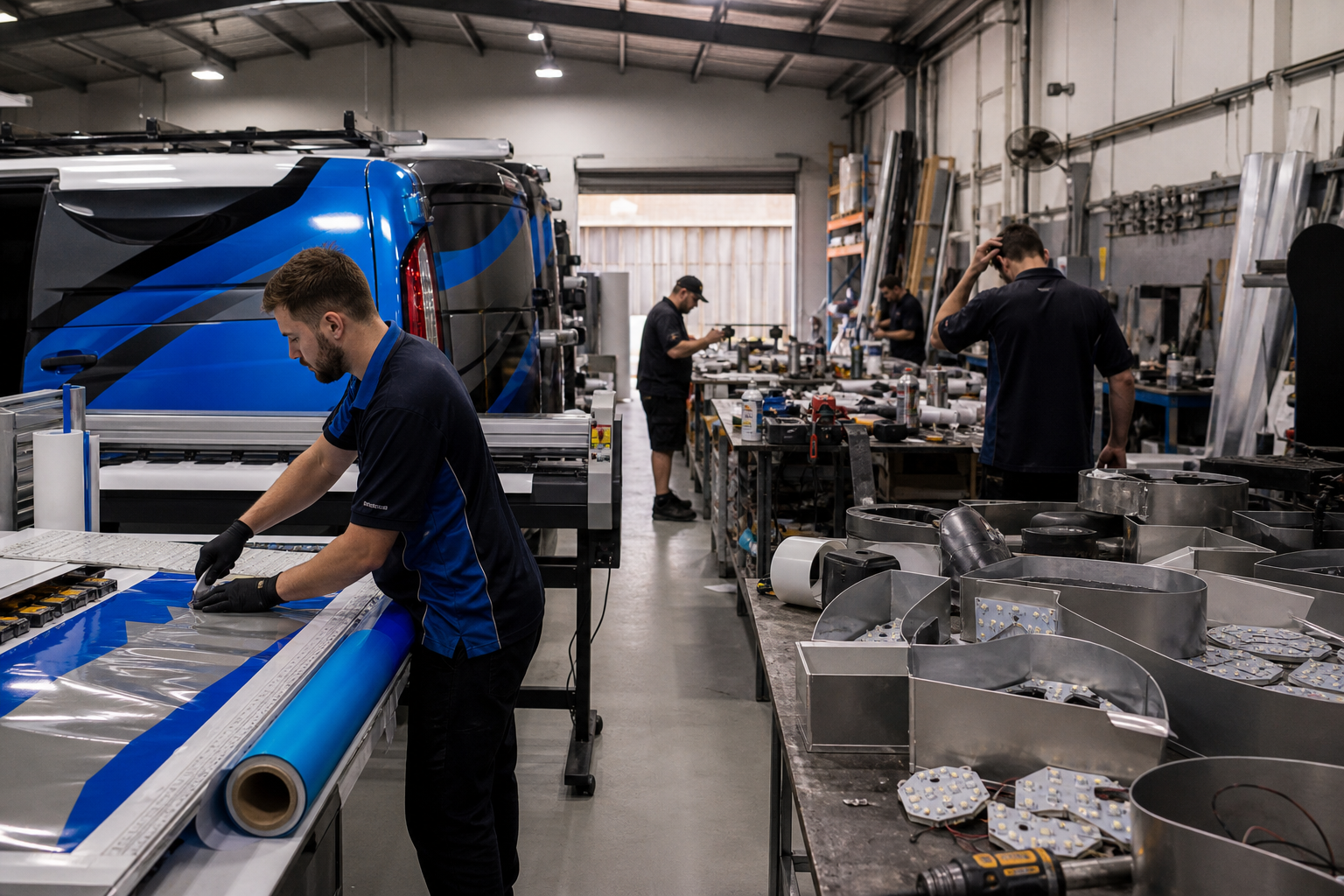
The appeal is easy to understand
For many sign shops, the thought process is simple: we regularly buy fabricated letters, so why not buy a letter bender, router, and the machinery to make them ourselves? Keep the margin, control the timing, and add another capability under our own roof.
We understand the appeal. As a trade fabricator, we are not neutral on the question. But we have also seen the other side of it first-hand. Over the years, some customers have left to bring fabrication in-house, then returned 12 months later after learning what the change actually demanded of their time, staff, and profit.
This is not an argument that every shop should outsource forever. Some businesses have the volume, people, space, and commitment to build a successful fabrication department. The point is to make the decision with the full cost in view, not just the price of the first machine.
The machine is only the entry ticket
A new letter bender and router setup can be a serious investment before a single sellable letter leaves the workshop. As a simple example, a shop might spend $150,000 on a new router, letter bender, tooling, software, and initial consumables. Buying second-hand may reduce the upfront figure, but it can also introduce service, compatibility, and reliability questions.
That $150,000 does not include finance costs, extra benches and jigs, extraction, electrical work, material stock, adhesives, LEDs, acrylic, maintenance, replacement parts, insurance, power, or the floor space the equipment occupies. Spread the original $150,000 across five years and it is $2,500 per month before finance, labour, materials, mistakes, or a quiet period.
The question is not only, “Can we buy the machinery?” It is, “Can we keep it productive enough to pay for itself without hurting the work that already pays the bills?”
A letter bender does not make someone a fabricator
A machine can bend a return, but it cannot teach the person operating it how to build a good letter. It cannot decide the right material for the application, allow for drainage and thermal movement, position LEDs for even illumination, or make a sign easy to service after installation.
Good fabricated signage is built from hundreds of small decisions. Letter depth, return material, face fit, glue quality, material quality, internal bracing, cable paths, power supplies, mounting methods, transport protection, and weather exposure all affect the finished result. Many of those details are trade knowledge learned through repetition, failures, and fixing the jobs that did not go to plan. (Ask us how we know… cough cough)
The risk is not that your first letter will look imperfect. The risk is that a letter can look acceptable in the workshop and still fail later: water ingress, uneven illumination, loose returns, failed paint, poor welds, or mounting problems. By then, the cost is not a test piece. It is a site visit, replacement parts, lost time, and your reputation with the client.
Someone still has to learn it
Machinery needs an operator who has time to learn it properly. That is often the cost owners underestimate.
If your team is already busy with wraps, vinyl, print, installs, quoting, and customer service, who will absorb the learning curve? Who has time to run test pieces, learn the software, refine files, set up jigs, troubleshoot errors, order materials, and build repeatable processes? When that person is learning, who covers their existing profitable work?
There is also a people question. A great installer, printer, or wrapper may not want to become a metal fabricator. Asking a busy team to take on a complex new trade can lead to rushed jobs, stress, rework, and missed deadlines in the departments that were already working well.
The first year can be expensive
We have heard a familiar story from customers who tried this path. The equipment arrived, the team was excited, and the first jobs looked like a saving on paper. Then production took longer than expected. Materials were ordered incorrectly. Multiple jobs needed to be remade. A staff member became the only person who knew how to run the machine. Other work waited while problems were solved. This isnt attractive from a HR perspective either, what if the staff member leaves?
Twelve months later, some have come back to us, not because bringing fabrication in-house was impossible, but because it had pulled focus and capital away from the parts of their business that were already profitable. The equipment had to be fed with work every week, while their core services still needed attention.
That experience is not universal, but it is a real risk worth pricing into the decision.
Run the numbers beyond the purchase price
Before committing, work through a conservative business case:
• What is the total installed cost, including machinery, consumables, stock, setup, maintenance, and finance?
• How many hours of skilled labour will each job really take while the team is learning?
• How much fabrication volume will you need each month to cover the fixed costs?
• What happens to your existing wraps, print, vinyl, or install work when staff are tied up?
• Can you carry the cost of rework, warranty jobs, and slow periods?
• Do you have at least two trained people, so the department does not rely on one operator?
• Is fabrication where your best margin and competitive advantage genuinely sit?
If the answer is yes, investing may be the right move. If the numbers only work when every machine is busy, every job goes right, and your existing team has spare time, the plan needs more margin for reality.
Growth does not have to mean doing everything yourself
Outsourcing fabrication is not giving up control of the client relationship. You can quote the complete job, manage the project, and install the sign while using a specialist trade fabricator for the part that needs dedicated equipment, processes, and experienced people.
For many shops, that means saying yes to more fabricated-signage work without taking on $150,000 or more in machinery, the pressure of creating a new department, or the risk of learning on paid client jobs. It keeps staff focused on the work they know, enjoy, and do profitably.
Do a quick cost analysis of all the current work that goes through your shop, all the wraps, prints, installs, etc. Column A, you keep focusing on all of that work and when a letter job comes up, your margin goes on top and you charge install accordingly. Column B, All of the above, but with the addition of a letter bender, router, stock, staff, and other overheads. Are you doing enough to make the investment worthwhile? Or were you sold a pipe dream? (Should have said letter dream)
Make the decision for your business, not the brochure
Bringing letter fabrication in-house can be a sound investment for the right business. It needs enough consistent volume, capital beyond the initial purchase, time to train, suitable staff, workshop capacity, and a willingness to treat fabrication as a specialist trade, not an add-on that runs itself.
If those foundations are not there yet, keeping fabrication with a trade specialist can be the more profitable decision. At Aussie 3D Fabrications, we help sign shops take on fabricated-signage projects while they stay focused on the work that makes their own business strong.